Can AI Detect Cancer Earlier Than Humans?
The Medical Revolution That Could Save Millions of Lives
For decades, one of the greatest challenges in medicine has been detecting cancer early enough to significantly improve outcomes.
The earlier cancer is found, the more treatment options are available and the higher the chances of survival. Yet many cancers remain difficult to detect in their earliest stages because symptoms often appear only after the disease has progressed.
Today, artificial intelligence (AI) is emerging as one of the most powerful tools in the fight against cancer. Researchers, hospitals, and healthcare companies around the world are using advanced AI systems to analyze medical images, genetic data, pathology slides, blood tests, and patient records with unprecedented speed and accuracy.
The question many experts are now asking is:
Can AI detect cancer earlier than human doctors?
The answer is increasingly becoming yes—at least in certain situations.
While AI is not replacing physicians, it is rapidly becoming an invaluable partner that may help identify cancers earlier than ever before.

Why Early Detection Matters
Cancer is often easier to treat when discovered before it spreads.
According to many cancer specialists, survival rates for certain cancers can increase dramatically when diagnosed in Stage 1 rather than Stage 3 or Stage 4.
For example:
- Early-stage breast cancer has significantly higher survival rates than advanced disease.
- Colon cancer found through screening is often highly treatable.
- Lung cancer, one of the deadliest cancers worldwide, becomes far more manageable when identified before symptoms develop.
The challenge is that human eyes and traditional screening methods can sometimes miss subtle warning signs.
This is where AI is beginning to make a major difference.
How AI Detects Cancer
Artificial intelligence excels at finding patterns within massive amounts of data.
Unlike humans, AI systems can analyze millions of medical images, research studies, and patient records in a fraction of the time.
Modern AI cancer detection systems are being trained using:
- Mammograms
- CT scans
- MRI scans
- Pathology slides
- Blood biomarkers
- Genomic sequencing data
- Electronic health records
By studying enormous datasets, AI learns to recognize patterns associated with cancer that may be difficult for humans to identify.
In some cases, AI can detect microscopic abnormalities that would otherwise go unnoticed.
AI and Medical Imaging
One of the most promising applications involves radiology.
Every day, radiologists review thousands of images searching for tiny abnormalities.
AI systems can assist by:
- Highlighting suspicious regions
- Prioritizing high-risk scans
- Reducing missed diagnoses
- Improving consistency between readers
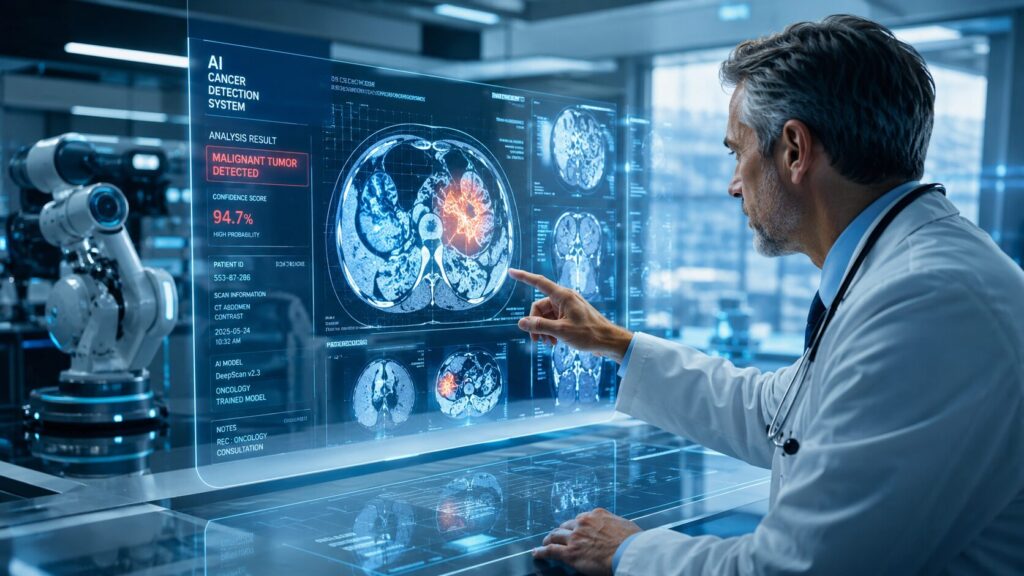
Researchers have demonstrated that AI can perform at levels comparable to expert radiologists in certain image-analysis tasks.
Rather than replacing radiologists, AI acts as a second set of eyes that never gets tired and can review every pixel with equal attention.
This partnership may improve both speed and accuracy.
Breast Cancer Detection
Breast cancer screening has become one of the most successful examples of AI-assisted medicine.
AI-powered mammography systems have shown the ability to identify subtle abnormalities that may indicate cancer before they become obvious to human reviewers.
In some studies, AI systems reduced false negatives while also decreasing unnecessary follow-up testing.
This could lead to:
- Earlier diagnoses
- Less patient anxiety
- Lower healthcare costs
- Improved survival rates
For millions of women undergoing annual screening, even small improvements in detection rates can have a profound impact.
Lung Cancer Detection
Lung cancer remains one of the leading causes of cancer-related death worldwide.
The disease is particularly dangerous because symptoms often do not appear until later stages.
AI is helping physicians analyze low-dose CT scans used for lung cancer screening.
Advanced algorithms can identify tiny nodules and subtle changes that may indicate developing tumors.
Some AI systems can even estimate future cancer risk based on imaging features that humans may not recognize.
This capability could help physicians intervene earlier and potentially save lives.
AI and Pathology
Pathologists play a critical role in diagnosing cancer by examining tissue samples under a microscope.
Traditionally, this process requires painstaking review of thousands of cells.
AI-powered digital pathology systems can rapidly analyze slides and identify suspicious areas for closer examination.
Benefits include:
- Faster diagnosis
- Improved accuracy
- Better consistency
- Reduced workload for specialists
In some cases, AI has identified patterns associated with aggressive cancers that were previously difficult to detect.
The Rise of Liquid Biopsies
Perhaps one of the most exciting developments involves blood-based cancer screening.
Researchers are developing “liquid biopsies” that look for tiny fragments of tumor DNA circulating in the bloodstream.
These tests generate enormous amounts of data.
AI helps analyze complex molecular patterns and identify signals that may indicate cancer long before symptoms develop.
The long-term vision is simple but revolutionary:
A routine blood test that could detect multiple cancers years before traditional diagnosis.
While this technology is still evolving, many experts believe it represents one of the most promising frontiers in oncology.
AI and Personalized Cancer Risk Prediction
Cancer detection is only part of the story.
AI is also being used to predict who is most likely to develop cancer in the future.
By analyzing:
- Family history
- Genetics
- Lifestyle factors
- Medical history
- Environmental exposures
AI systems can estimate individual cancer risk and recommend personalized screening strategies.
This shift from reactive medicine to predictive medicine could fundamentally transform healthcare.
Instead of waiting for disease to appear, physicians may increasingly focus on prevention and early intervention.
Can AI Outperform Human Doctors?
The answer depends on the task.
In highly specialized image-recognition applications, AI can sometimes identify abnormalities that humans miss.
However, medicine involves much more than pattern recognition.
Doctors consider:
- Symptoms
- Medical history
- Patient preferences
- Physical examinations
- Emotional and psychological factors
AI currently lacks the broader clinical judgment and human understanding required to provide comprehensive medical care.
The most effective model is likely collaboration.
Research increasingly suggests that AI combined with experienced physicians often performs better than either one alone.
Challenges and Limitations
Despite its promise, AI is not perfect.
Important challenges remain:
False Positives
AI may identify abnormalities that are not actually cancer, leading to unnecessary testing and anxiety.
Data Quality
AI systems are only as good as the data used to train them.
Biased or incomplete datasets can affect performance.
Privacy Concerns
Medical AI requires access to large amounts of patient information, raising important questions about data security and privacy.
Regulatory Oversight
Healthcare organizations must ensure AI systems are safe, effective, and transparent before widespread adoption.
The Future of Cancer Detection
Many experts believe we are entering a new era of cancer care.
Future screening programs may combine:
- AI imaging analysis
- Genetic testing
- Wearable health monitoring
- Blood-based cancer detection
- Personalized risk assessment
Together, these technologies could help identify cancers at their earliest and most treatable stages.
The ultimate goal is not simply to diagnose cancer faster.
It is to prevent suffering, improve survival, and help people live longer, healthier lives.
Final Thoughts
Artificial intelligence is rapidly transforming cancer detection.
While AI is unlikely to replace oncologists, radiologists, or pathologists anytime soon, it is becoming an extraordinarily powerful tool that enhances human expertise.
In many situations, AI can already identify patterns and warning signs that may escape even highly trained specialists.
As technology continues to advance, the partnership between physicians and artificial intelligence may lead to one of the greatest improvements in cancer care in modern medical history.
The future of cancer detection may not belong to humans or machines alone—it may belong to both working together.
